

The treatment
Transcranial Magnetic Stimulation
Non-invasive, drug-free, and cleared for people whose antidepressants have not worked. You stay awake, you feel a tapping on your head, and about twenty minutes later you drive yourself home.
Why an alternative exists at all
Medication does not work for everyone, and that is documented
If you have tried several antidepressants without getting your life back, the research says you are in ordinary company. The STAR*D trial, one of the largest studies of antidepressant treatment ever run, found:
Those two lines together describe the trap a lot of people are in: each additional medication is less likely to work and more likely to be intolerable. TMS is a different mechanism entirely. It is not a pill, it does not travel through your bloodstream, and it does not carry that side-effect profile.
These figures come from published research on antidepressant medication. They describe medication outcomes generally, not outcomes at this clinic.
Watch first
What TMS actually is, in three minutes
A short introduction filmed at the clinic. It covers what the treatment does, what a session feels like, and who it is for — in plain language, with nothing to prepare beforehand.
Runs 3 minutes 10 seconds, with sound. Everything covered in the video is also written out in the sections below.
How it works
Magnetic pulses, about the strength of an MRI
Depression is associated with under-activity in specific regions of the brain. TMS uses focused magnetic pulses, roughly the same strength as those used by an MRI machine, to stimulate those under-functioning areas. Nothing enters your body. Nothing is implanted. There is no anesthesia and no hospitalization.
Treatment at our clinic is delivered on an FDA-cleared TMS therapy system. That system is cleared for the treatment of major depressive disorder in adults who have not achieved satisfactory improvement from prior antidepressant medication in the current episode, and for adolescents aged 15 and older as an addition to antidepressant medication — which is to say, cleared for exactly the situation most of our patients arrive in.
What a session is like
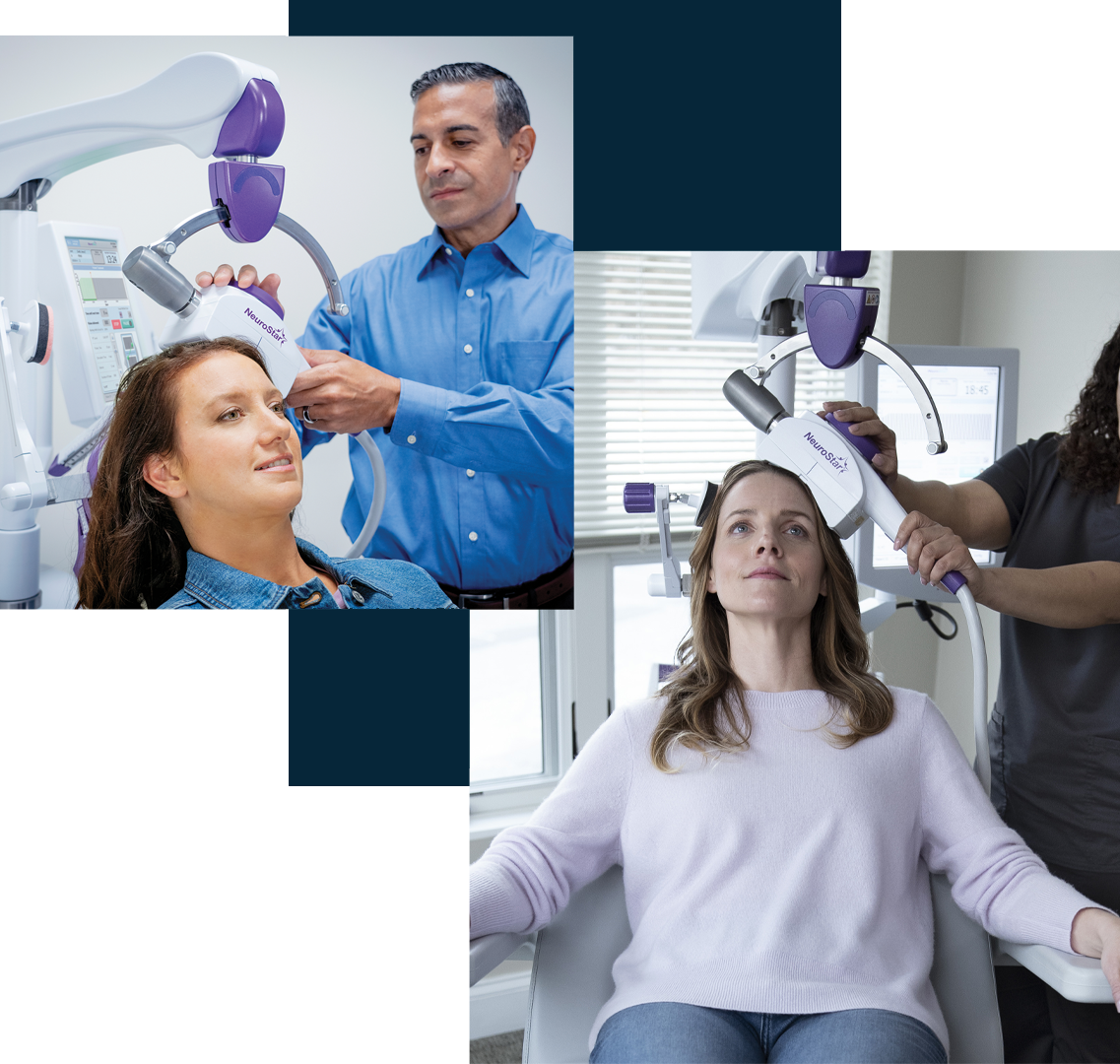
Twenty minutes, in a chair, wide awake
- You sit downYou recline in a treatment chair, fully clothed and fully awake. Nothing is sedating you.
- The coil is positionedA specially trained technician positions the treatment coil against your head, at the mapped location for your treatment.
- About twenty minutes passYou feel a tapping sensation on your head. Most people look at their phone, read, or talk with our staff.
- You leaveNo recovery period and no driving restriction. You go back to your day.
- You come backFive days a week for about seven weeks. Consistency is what makes the course work.
Treatment is administered by specially trained technicians and overseen by a medical provider.
Side effects
What we tell everyone before they start
The only consistent side effect of TMS is mild scalp discomfort, which usually resolves after the first week.
Some patients experience mild to moderate pain or discomfort at or near the treatment site during that first week. It is manageable with over-the-counter medication such as ibuprofen or Tylenol. There are no long-term side effects.
We would rather you know that before you start than discover it on day three.
Insurance
Covered by most major insurance companies
If you meet your insurer’s criteria, TMS therapy is covered by most major insurance companies. Coverage is checked per patient.
We verify your specific benefits before you commit to a course of treatment, and we give you an estimate of your out-of-pocket cost before you start. That estimate is based on what your insurer tells us, so it is an estimate rather than a guarantee. Call (435) 900-7816 or book a consultation and we will run it for you.
- We check your benefits for you — you do not have to call your insurer yourself.
- You get the number before you commit, not after.
- The consultation itself is free either way.
Questions
What people ask us about the treatment
Is TMS the same thing as electroconvulsive therapy?
No. ECT induces a seizure under general anesthesia and requires recovery time. TMS uses focused magnetic pulses while you sit awake in a chair, and you drive yourself home afterwards. They are different treatments.
Do I have to stop taking my medication?
No. TMS does not require you to stop anything. Any change to your medication is a conversation between you and your prescriber.
How soon would I notice anything?
Most people do not notice much in the first couple of weeks. Improvement more often shows up after that, and for many people it continues to build after the course has finished. It varies from person to person, and your clinician will track your symptoms as you go so progress is measured rather than guessed at.
Who should not have TMS?
TMS is generally not suitable for people with certain non-removable metal implants in or near the head. This is one of the things the free consultation screens for, and it is a short conversation.
What happens if it does not work for me?
We will tell you. We would rather have that conversation honestly than keep someone in a course of treatment that is not helping them.
Common questions
The three things people ask first
- Does TMS actually work? What the research shows, what we see at our clinic, and the part nobody can tell you in advance.
- Will my insurance cover it? What most plans require, what it is likely to cost, and how we check your benefits.
- Does it hurt? What a session is actually like, and the honest answer on discomfort.
Find out if TMS is right for you
A free 30-minute consultation. We will look at your history, check your benefits, and tell you honestly whether this is worth your time.